
Gurusthan in Shirdi is the small neem-tree shrine behind the Samadhi Mandir. The Sansthan says Baba spent most of his time here when he first came to the village. Baba asked devotees to clean this spot and burn ud at it on Thursdays and Fridays. Whoever does so will prosper, he promised.
This site is an independent guide and is not affiliated with Shri Saibaba Sansthan Trust, Shirdi, nor endorsed by it. We take no bookings, donations or payments. For anything official, please use the Trust’s online services portal.
On This Page
Gurusthan in Shirdi at a glance
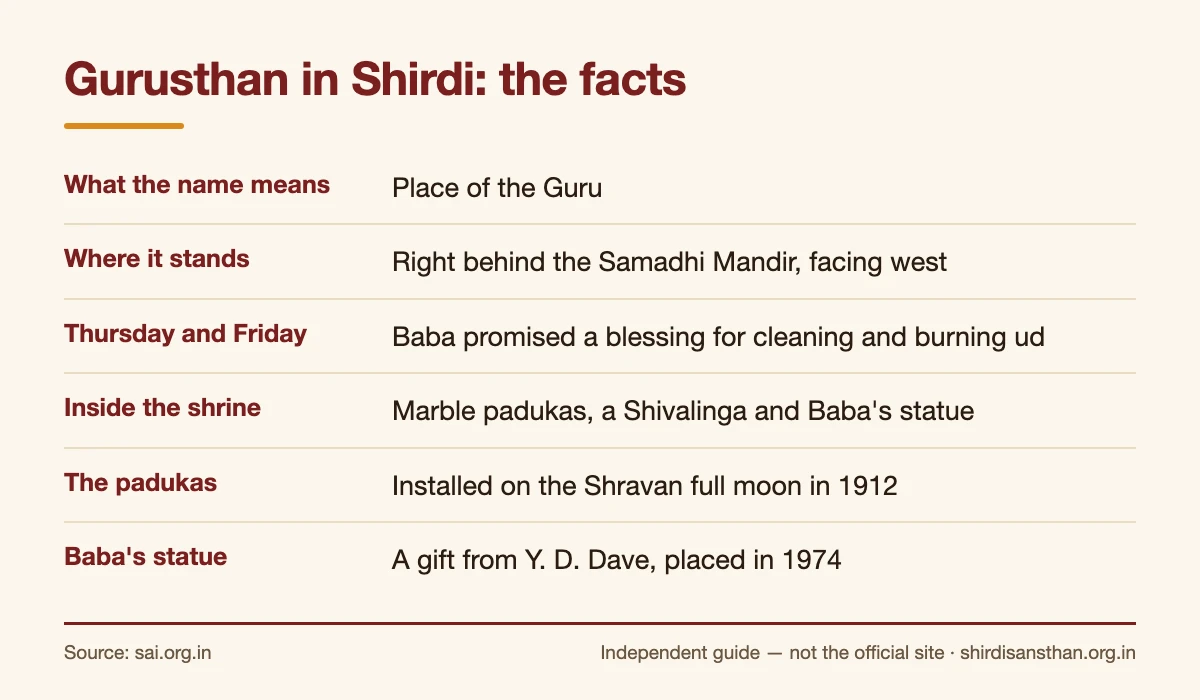
- The name means place of the Guru, because Baba pointed to his own Guru’s tomb by the neem tree.
- The shrine stands on a square platform a foot above the ground, and it faces west.
- Baba promised a blessing to whoever cleans the spot and burns ud there on a Thursday or a Friday.
- Marble padukas, a Shivalinga and a statue of Baba share the platform with the tree.
- The Sansthan lists Gurusthan among the temples a devotee should visit.
Where Gurusthan in Shirdi stands in the premises
The neem tree grows directly behind the Shri Sai Samadhi Mandir. So the shrine sits inside the main temple premises. Because its platform rises a foot off the ground, you step up to reach it.
The little temple above it faces west, and a spire crowns the inner shrine. Also, a newer temple has been built on the west side of the same neem tree.
What stands inside the shrine today
Gurusthan holds three things besides the tree. First come a pair of marble padukas on a pedestal. Then a Shivalinga, and then a statue of Baba.
Baba’s own time saw the padukas and the Shivalinga put in place. The statue came much later, in 1974, as a gift from Y. D. Dave.
That statue carries a quiet link to the main shrine. Specifically, the grandson of the sculptor who made the Samadhi Mandir statue carved it. Saint Shri Parnerkar Maharaj unveiled it.
Step closer and you see a large portrait of Baba on a raised seat inside the temple. A Shiva pindi stands before the portrait, with its shalunka turned to the north. Baba set up that pindi with his own hands. Also, a crystal Nandi sits close beside it.
The room the villagers found beside the neem tree
Beside the tree stood the wada of Rao Bahadur Hari Vinayak Sathe. Villagers once dug under an arch below its staircase. What they uncovered stopped them short. A room 10 feet by 10 feet lay hidden there, holding a seat, lamps, a tiger-face skin and a japmala.
So they turned to the young fakir and asked him what it was. He told them it was his Sadguru’s place. The villagers then closed the dug-out spot for good. Later the Sansthan committee of that time raised the little temple everyone knows today as Gurusthan.
Baba’s instruction for Thursday and Friday
Baba laid his right hand on the east-facing branch of the tree. Then he spoke about its leaves and about the ground beneath them. From that day, he said, the bitterness would leave the leaves.
Whoever smeared and cleaned the spot and burned ud there on a Thursday or a Friday would prosper. The Sansthan’s account of the temple premises puts the same promise plainly. Allah blesses whoever keeps this place clean and burns incense on Thursdays and Fridays. Thursday is sacred to Hindus and Friday to Muslims, so the pairing is deliberate.
During Baba’s lifetime the spot lay completely open. So it looked nothing like the paved, enclosed area a devotee walks into now.
The padukas of 1912 and the Shravan full moon
In 1912 Dr. Ramrao Kothare had a pair of padukas made in Mumbai and sent them for Baba. Upasani Maharaj purified them first and performed the other sacred rites. Then a devotee carried them on his head from the Khandoba temple to Baba.
Baba touched them with his hand and gave an order. These were the feet of Sacchidanand Parameshwar, he said. So they belonged under the sacred neem tree. The padukas accordingly went in beneath the tree on the full moon of the month of Shravan.
A third aarti began at the spot once the padukas stood in place. Daily aarti already ran in Sathe Wada and Dixit Wada.
Then G. K. Dixit took on the duty of officiating the new one.
The neem tree, the sweet leaves and the pradakshina
Neem leaves normally taste bitter. Devotees hold that the leaves of this tree taste sweet when chewed. Naturally they see Baba’s hand in it. Still, treat that as devotion rather than an invitation to pluck anything.
Since the 1980s more and more devotees have walked pradakshina around the tree, and so around the tomb beneath it. You can often see people circling it through the day and the night. Others go only to sit, because Gurusthan in Shirdi is a powerful place for quiet.
Visiting Gurusthan in Shirdi: practical notes
The Trust’s own list of temples to visit opens with the Shri Sai Samadhi temple. Gurusthan in Shirdi comes immediately after it, ahead of Dwarkamai, the Hanuman temple and the Chavdi. So you are not adding an extra stop by going there.
Food offerings reach the shrine too, since the Sansthan offers food to Baba here as well as at the Samadhi Mandir. If someone in your group needs help, a first aid centre sits near the shrine at butti wada. Others sit along the darshan queue and on the ground floor of Sai Niwas. Ask a security guard, because the Sansthan asks devotees to do exactly that.
The same walking round takes in the Chavadi, which the Trust also lists among the temples to visit. Families can use our Shirdi with kids guide to pace the complex. For bookings, donations and official notices, go to the Trust’s own website.
Featured photo: Photographer in Shirdi, India via Wikimedia Commons, Public domain, adapted (cropped, shaded and titled).
