Shirdi Festivals 2026
Ram Navami, Guru Purnima, Punyatithi and Datta Jayanti — the four nights when all of Shirdi shines
Four nights of the year transform Shirdi from a busy pilgrim town into something close to a national mela. The Shirdi festivals of 2026 — Ram Navami, Guru Purnima, the Punyatithi-Vijaya Dashami triad, and Datta Jayanti — draw lakhs of devotees from every corner of India and the diaspora. Each festival is a three-day affair, with dawn-to-night Aartis, palki processions, mass annadaan, cultural programmes and a steadily climbing energy that culminates in a single decisive evening. If you can plan your yatra around even one of these festivals, you will see a side of Shirdi that the rest of the year cannot show you.
The four big festivals at a glance
Ram Navami
26 March 2026 (Thursday)
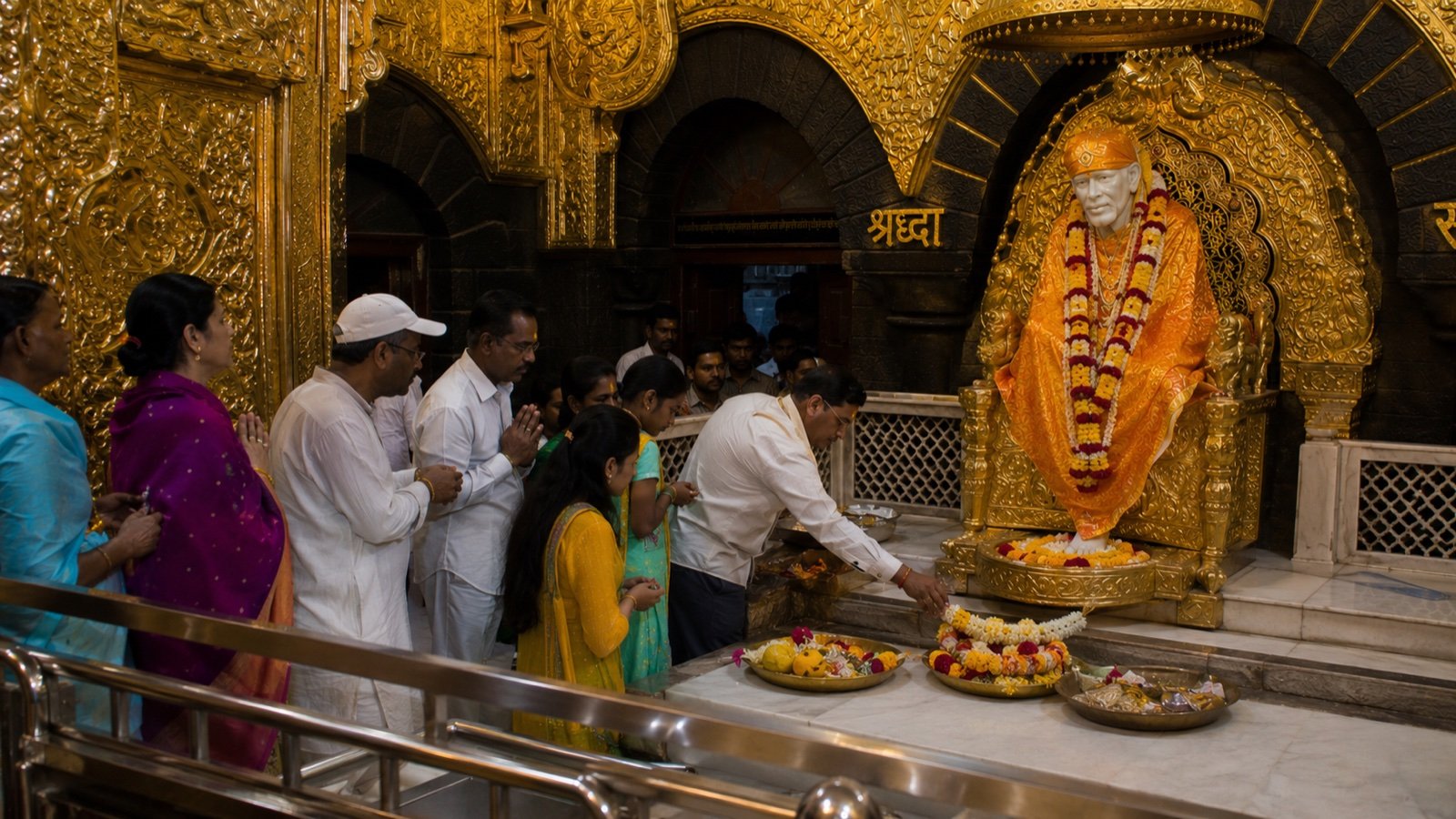
The birthday of Lord Rama, but in Shirdi it is also the anniversary of the day, in 1897, when Mhalsapati first carried Sai Baba’s palanquin through the village. The temple is decorated with floral arches, a special Ram darbar is built inside the Samadhi Mandir, and a grand palki procession is held on the night of the main day. The Sansthan opens additional darshan queues and runs round-the-clock Prasadalay. Crowds: 4–5 lakh devotees over three days.
Guru Purnima
29 July 2026 (Wednesday)
The full-moon day dedicated to the Guru, and for Sai devotees the highest spiritual occasion of the year. A special abhishek of Sai’s padukas is performed at dawn, and devotees throng to Gurusthan with milk and water. The night of Guru Purnima sees a moonlit palki procession from Samadhi Mandir, often considered the most beautiful procession of the year. Crowds: 3–4 lakh over three days.
Punyatithi / Vijaya Dashami
20 October 2026 (Tuesday)
The death anniversary of Sai Baba (1918), observed on Vijaya Dashami / Dussehra. This is the most emotional of all Shirdi festivals — the day Baba left his body. A solemn morning Aarti is followed by a Maha Aarti at noon. Devotees offer flowers at the Samadhi continuously through the day; the evening ends with a victory-procession echoing Vijaya Dashami. Crowds: 5–7 lakh over three days, the highest of the year.
Datta Jayanti
23 December 2026 (Wednesday)
The birthday of Lord Dattatreya — a form Sai Baba is regarded as having embodied. A Datta yajna is held in the Samadhi Mandir, the Chavadi sees a special procession, and the day is observed quietly but with deep reverence. Smaller crowds than the others: about 1.5–2 lakh.
Ram Navami at Shirdi (26 March 2026)
Ram Navami is a three-day festival in Shirdi, beginning on the morning of 25 March 2026 (Wednesday) with a flag-hoisting at the Dwarkamai. The Samadhi Mandir is opened almost around the clock. At dawn on 26 March, a Ram-darbar of idols of Rama, Sita, Lakshman and Hanuman is set up beside Sai’s samadhi. The afternoon brings a vast palki procession around the temple lanes, with horses, brass bands and floral floats. By night, a literary discourse (kirtan) is held inside the Sabha Mandap.
Crowd tip: Ram Navami falls in the start of the Maharashtra summer. Carry water, an umbrella and electrolytes. Queues in the open courtyards can reach 6+ hours on the main day; VIP passes are highly recommended.
Guru Purnima at Shirdi (29 July 2026)
Guru Purnima begins with a pre-dawn abhishek of the Sai padukas at the Samadhi Mandir at 4 AM. Throughout the day, devotees take guru-diksha at Gurusthan, read chapters from the Sai Satcharitra and offer cooked food at the Prasadalay. The Sansthan organises a continuous “akhand parayan” reading of the Satcharitra in the Sabha Mandap. The night procession on the full-moon evening is unforgettable — the palki winds through silver-lit lanes accompanied by classical bhajans.
Crowd tip: monsoon is in full force; pack rainwear and waterproof bags. Carry the Aarti book in a polybag.
Sai Punyatithi / Vijaya Dashami (20 October 2026)
The Punyatithi is the most spiritually charged festival of the year in Shirdi. The night before (19 October 2026, Monday), the entire town keeps a “ratri jagaran” — overnight vigil with bhajans. On 20 October, the day Baba left his body on Vijaya Dashami in 1918, an emotional morning Aarti is sung. The Samadhi is decked with white roses. A special Maha Aarti at noon is followed by a victory-procession on the streets — even though it commemorates Baba’s departure, it is celebrated as his “great victory” over the cycle of birth and death.
Crowd tip: This is the single most crowded day of the year. Walking distances inside the temple complex can take twice as long as usual. Children below five and the elderly are advised to take darshan during the days flanking the main date, not on the main day itself.
Datta Jayanti (23 December 2026)
The smallest of the four festivals, but spiritually rich. A Datta yajna with Vedic chanting is performed in the Samadhi Mandir from morning. The Dwarkamai dhuni is fed special offerings, and the Chavadi procession on this Wednesday evening is open to a much larger crowd than a regular Thursday. The weather is cool and pleasant — December is in fact one of the most comfortable months to visit Shirdi.
Do not fear, I am always with you.
Festival crowd flow — lessons from Ram Navami
The palki procession is a public street event — no pass is needed to watch it. The decorated palki leaves Khandoba Mandir and moves through Pimpalwadi Road, Gurusthan and Dwarkamai; a spot near Lendi Baug gives a clear view. When the main day falls on a Thursday, the regular weekly Chavadi procession also runs after Shej Aarti — on a festival Thursday it is the most attended of the year, so take your place on the route early.
On the first morning of the utsav, the Samadhi Mandir closes to general darshan for about 90 minutes during the special abhishek — plan your darshan before or after it. General darshan stays free and open through all three days, and mahaprasad tokens are free at the Prasadalay extension grounds, with the kitchen serving until food runs out. Aarti passes for the main day sell out first — book a flanking day if you miss them.
- Travel in pairs minimum — solo navigation in a festival crowd at the Samadhi Mandir is risky.
- Fix one meeting point in case you get separated; the Lendi Baug entrance is the easiest to find.
- Carry one phone per family group — cloakroom queues take 30–45 minutes on festival days.
- Tag your children — write your phone number on a tag pinned inside the child’s shirt.
Booking-window reality for the big festivals
All official bookings — darshan, aarti and rooms — run only through the Shri Saibaba Sansthan Trust’s own portal, sai.org.in. The Trust authorises no agents and no third-party booking websites; treat anything else claiming to sell festival darshan or rooms as fake. The Sansthan does not publish a fixed advance-booking window — festival slots appear on the portal on a rolling basis and fill quickly once visible, so book the moment your dates are firm.
Two caveats for the heaviest days: paid priority and aarti passes are limited on festival dates, and the Sansthan can restrict or suspend paid passes entirely on the biggest days — keep a general-queue plan as backup. On the main Punyatithi day the Samadhi Mandir has traditionally stayed open through the night, and the small hours after the palki returns are far calmer than the mid-morning-to-mid-afternoon peak.
Private hotels raise tariffs sharply for the utsav nights — the later you book, the worse the rates get — while Sansthan rooms remain the best value in town and disappear first. Expect parking restrictions near the temple across the utsav days, and reserve trains from Sainagar Shirdi as early as booking opens — festival demand on this line is heavy.
General tips for any festival visit
- Travel two days before or after the main festival date if your spiritual goal is depth, not crowd-experience. Aartis are still performed; the chaos is far less.
- Book refundable hotels at first, then confirm closer to the date as your travel firms up.
- Use cloakrooms aggressively — the Sansthan offers free shoe and bag deposit near the Samadhi Mandir gate.
- Eat at the Prasadalay — during festivals, it serves over a lakh meals a day, completely free.
- Keep an emergency contact list with the Sansthan helpline +91 2423 258500 and your hotel’s number.
- Wear the recommended dress code (see our Shirdi yatra rules).
- Pick up the official Sansthan festival schedule when you arrive — minor timings shift each year.
When is Sai Baba’s birthday? The honest answer
Shirdi Sai Baba’s date of birth is not known, and Shirdi holds no birthday festival. The Shri Saibaba Sansthan Trust states on its own website that “nobody knew the parents, birth or birthplace of Sai Baba” and that no convincing information has ever been obtained. Its official chronology gives only an approximate birth year — 1838 — citing Shri Sai Satcharita chapter 10. The three festivals the Trust celebrates at Shirdi are Ram Navami, Guru Purnima and Vijaya Dashami.
Three different answers circulate online and they are not the same thing. Here is what each one actually refers to.
| What you may have read | What it actually refers to | 2026 date |
|---|---|---|
| Sai Jayanti on 28 September | The Pathri tradition, from a claimed birth at Pathri in Parbhani district on 28 September 1835. Maharashtra recognised Pathri as the birthplace in 2020; the claim is disputed, and the Sansthan itself publishes no birth date. | Monday, 28 September 2026 |
| Baba’s Jayanti at Shirdi | Shirdi marks no birthday. Its spring utsav is Ram Navami, which here also carries the 1897 anniversary of the first Sai palanquin procession through the village. | Thursday, 26 March 2026 |
| “Sai Baba’s birthday is 23 November” | A different person. That is Sathya Sai Baba of Puttaparthi, born 23 November 1926 — eight years after Shirdi Sai Baba’s mahasamadhi in 1918. | Monday, 23 November 2026 |
If you want to be in Shirdi on the day the Sansthan marks most grandly, it is not a birthday at all — it is Sai Punyatithi on Tuesday, 20 October 2026, the anniversary of Baba’s mahasamadhi, and the most crowded day of the Shirdi year.
Frequently Asked Questions
When is Ram Navami 2026 in Shirdi?
The main Ram Navami day at Shirdi falls on Thursday, 26 March 2026, with the three-day festival running from 25 to 27 March 2026. Expect 4–5 lakh devotees across the three days.
When is Guru Purnima 2026 at Shirdi?
Guru Purnima at Shirdi is on Wednesday, 29 July 2026 — see the complete Guru Purnima 2026 utsav guide (Purnima tithi begins 6:18 PM on 28 July and ends 8:05 PM on 29 July; the utsav runs 28–30 July). The festival is a three-day event with palki processions and continuous Satcharitra parayan in the Sabha Mandap.
When is Sai Punyatithi 2026?
Sai Punyatithi 2026, which is observed on Vijaya Dashami, falls on Tuesday, 20 October 2026. This is the anniversary of Sai Baba’s mahasamadhi in 1918 and the most crowded day of the year in Shirdi.
When is Datta Jayanti 2026 at Shirdi?
Datta Jayanti, the birthday of Lord Dattatreya, is on Wednesday, 23 December 2026. Shirdi observes it with a Datta yajna in the Samadhi Mandir and a special Chavadi procession.
When is Sai Baba’s birthday in 2026?
Shirdi Sai Baba’s date of birth is not known. The Shri Saibaba Sansthan Trust states on its own website that nobody knew his parents, birth or birthplace, and its chronology gives only an approximate birth year of 1838. Shirdi holds no birthday festival. Devotees who follow the disputed Pathri birthplace account observe Sai Jayanti on 28 September, which in 2026 falls on a Monday.
Is Sai Baba’s birthday on 23 November?
Not Shirdi Sai Baba’s. That date belongs to Sathya Sai Baba of Puttaparthi, born 23 November 1926, who is a different person — Shirdi Sai Baba took mahasamadhi in 1918, eight years earlier. The Shirdi anniversary observed every year is Sai Punyatithi, on Tuesday, 20 October 2026.
How early should I book accommodation for Shirdi festivals?
Book at least 90 days in advance for any of the four festivals. Bhakt Niwas rooms are usually exhausted within hours of the Sansthan portal opening. Private hotels too sell out 60–90 days ahead.
Are festival darshan queues longer than usual?
Yes, dramatically longer. General queues on Punyatithi can stretch 6–8 hours. A prebooked VIP darshan pass is strongly recommended if you cannot stand for long periods.
Is there free food during Shirdi festivals?
Yes. The Sansthan Prasadalay serves free meals daily, and during festivals it scales up to over a lakh meals per day. Token counters operate continuously near the dining hall.
Which festival is best for first-time visitors?
If it is your first trip and you want the spiritual intensity of a festival without the maximum crowd, choose Datta Jayanti in December — pleasant weather, full ritual programme and far smaller crowds.
Sri Rama Navami 2026 — Pan-India Date & Muhurat
Sri Rama Navami at Shirdi is one of the three major festivals every year (alongside Guru Purnima and Vijaya Dashami). The festival in 2026 falls on Thursday, 26 March — see the complete Sri Rama Navami 2026 muhurat, vidhi, and Bhadrachalam Sita-Rama Kalyanam guide for aligning your Shirdi observance with the broader nationwide celebration.
