The Fakir who refused every label
A pilgrim's introduction to the life, words and lasting presence of Shri Sai Baba of Shirdi.
The Shirdi Sai Baba life story is unusual among Indian saints — almost nothing is known of his origins. Where he was born, who his parents were, whether he was Hindu or Muslim, even his real name: Baba never revealed any of it. He arrived in the small village of Shirdi as a young Fakir, sat under a neem tree, and stayed for the next sixty years. By the time he took mahasamadhi on Vijaya Dashami in 1918, millions across India already knew his name. This page is an independent biographical introduction; for all matters concerning the Samadhi Mandir today, the official source is the Shri Sai Baba Sansthan Trust.
Sai Baba — the essentials
The arrival — a boy under a neem tree
Local tradition holds that Sai Baba was first seen in Shirdi around 1858, a thin, dark-skinned boy of about sixteen, sitting in deep meditation under a neem tree on the outskirts of the village. He spoke little, accepted no food, and seemed indifferent to the curiosity of the villagers. The neem tree, remarkable for the sweet rather than bitter taste of its leaves at that spot, became known as Gurusthan — the place of the guru — and is still venerated today as the spot where Baba’s tapasya began.
The young Fakir disappeared after some months, returned a few years later in the wedding procession of one Chand Patil, and this time stayed. A villager named Mhalsapati greeted him with the words “Aao Sai” — welcome, saint — and the name stuck. He never confirmed or denied any other name.
Dwarkamai — sixty years in a ruined mosque
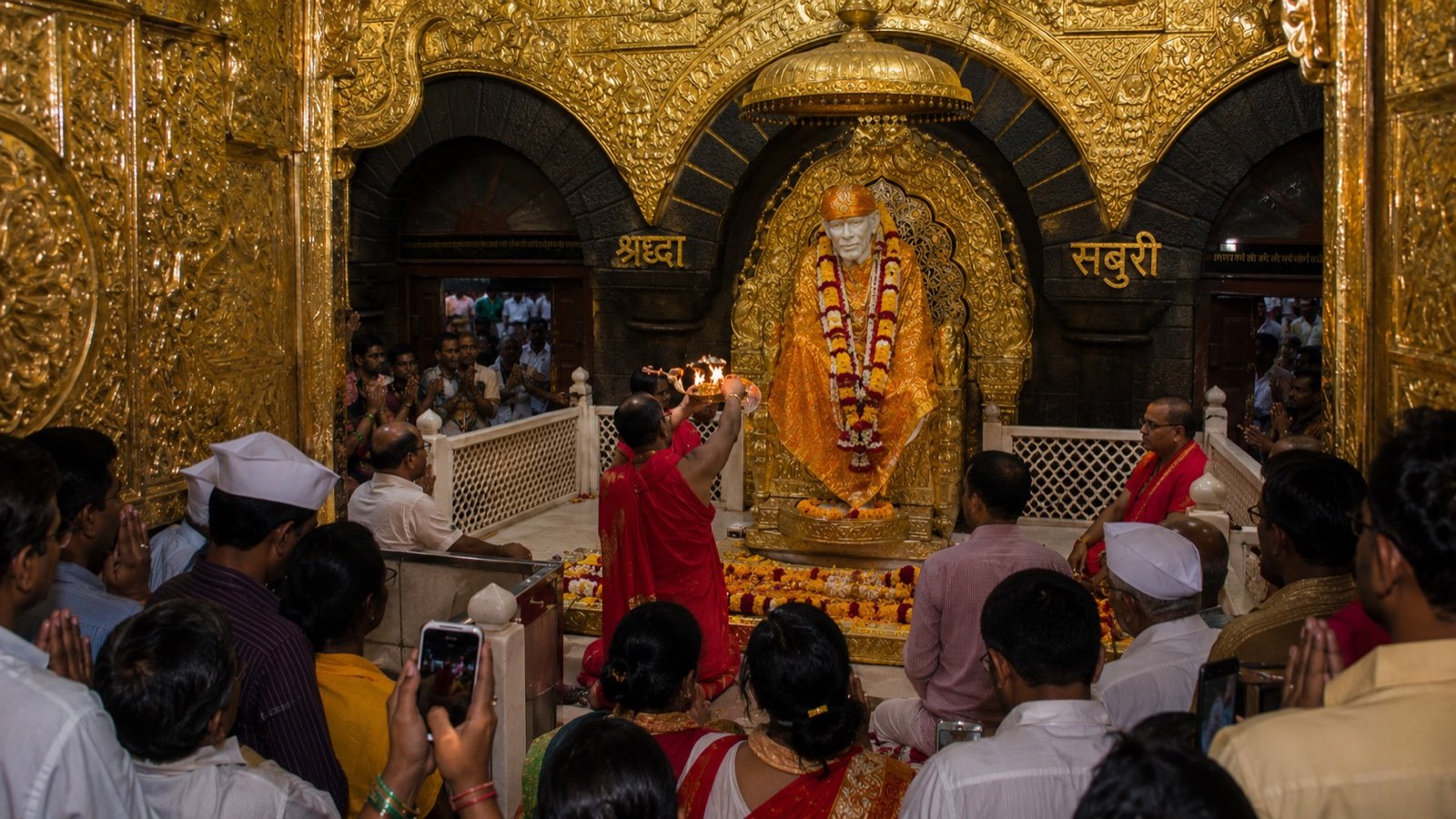
Baba chose for his home a dilapidated mosque on the edge of Shirdi that everyone else avoided. He named it Dwarkamai — “mother Dwarka” — and lived there for nearly six decades. He lit a sacred fire called the dhuni that has never been extinguished since. He sat on a slab of stone, leaned against a wooden post, slept on a wooden plank suspended from the rafters by old strips of cloth, and begged for his daily meal from only five fixed households in the village. Whatever he received went into a common pot for any visitor who came hungry.
Dwarkamai functioned as Baba’s clinic, his court, his school and his temple. He healed lepers with ash from his dhuni — the udi — gave grain to the starving, settled village disputes, told disciples the future in riddles, and answered every theological question with the same insistence: there is only one God, regardless of what name you call Him.
The teaching — Shraddha and Saburi
Sai Baba left no written work, no formal doctrine, no organised order of monks. Yet his teaching is remembered in two Marathi words he repeated through his life: Shraddha (faith) and Saburi (patience). Faith was not blind belief but unwavering trust that the Sadguru is already taking care of the devotee. Patience was the discipline to keep that trust alive even when life seemed to contradict it.
Around these two ideas he built a remarkably simple ethical framework — speak truthfully, do not steal, do not envy, feed the hungry, do not turn away the stranger, do not fear, and remember always that Sabka Malik Ek — there is only one Master of all. He insisted on no rituals, no temple construction, no fundraising. When devotees offered money he accepted it in the form of dakshina and gave nearly all of it away the same day to the poor of Shirdi.
Shraddha and Saburi — keep these two, and I am ever with you.
Stories from a life of miracles
The Sai Satcharitra — the principal hagiography of Sai Baba, written by Govind Raghunath Dabholkar in the 1920s — records hundreds of incidents from Baba’s life. A devotee’s child saved from cholera by a pinch of udi sent overnight. A railway accident averted because Baba refused to let a follower board the train. Drought-stricken fields revived by a single Baba waving his hand toward the sky. Baba appearing simultaneously in two cities. The miracles were never performed for show — they emerged quietly, in response to genuine devotion, and Baba always deflected praise upward: “Allah Malik. He is the doer; I am only His servant.”
Mahasamadhi — Vijaya Dashami, 15 October 1918
In the last year of his life Baba’s health declined. He continued to sit in Dwarkamai, continued to bless devotees, continued to feed every visitor. On the morning of Vijaya Dashami — the festival celebrating the victory of good over evil — Baba spoke softly to his closest disciples, asked to be moved to the Buty Wada nearby, leaned against Bayyaji Patil and gave up his body at around 2:30 PM. The date was 15 October 1918.
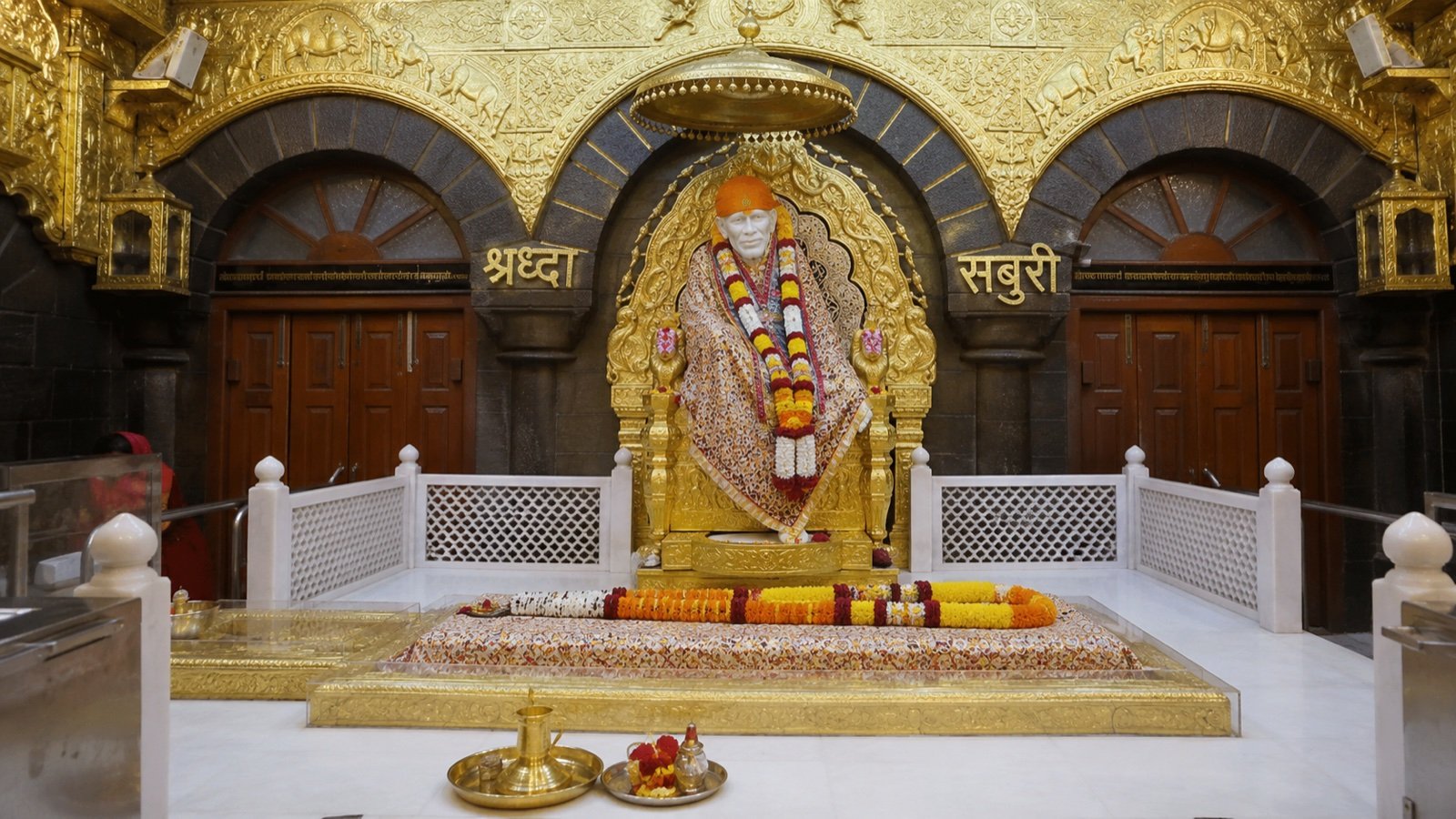
The Buty Wada had been built by the wealthy devotee Bapusaheb Buty as a Krishna temple. Baba himself had once told Bapusaheb, “I will sleep in your wada.” That prophecy turned the structure into the Samadhi Mandir, completed in 1922 over the spot where Baba was laid to rest. The white marble murti now installed there was carved by Balaji Vasant Talim of Mumbai and consecrated in 1954.
The Sai Satcharitra and the spread of devotion
Between 1923 and 1929 Govind Raghunath Dabholkar — a Bombay High Court official and Baba devotee — compiled the Marathi text known as Shri Sai Satcharitra, fifty-three chapters of biography, devotional poetry and recorded miracles. Baba himself had once told Dabholkar, “My stories will spread far and wide. Write them down.” The Satcharitra has since been translated into more than a dozen languages and is the principal scripture of Sai devotion. Weekly parayan — a seven-day cycle of reading the book — is one of the most common Sai practices in homes worldwide.
Through the twentieth century, disciples carried Baba’s name far beyond Shirdi. Hemadpant, Das Ganu, Tatya Patil, Shyama, Nana Chandorkar, Mhalsapati — these names recur in every Sai household. From Shirdi the devotion spread to Mumbai, Hyderabad, Chennai, and today there are Sai temples on every continent.
Sai Baba and inter-faith harmony
What makes Sai Baba’s life politically remarkable is his deliberate refusal to be claimed by any one religion. He lived in a mosque but allowed Hindu rituals there. He spoke Marathi peppered with Urdu and Persian. He greeted visitors with “Allah Malik” and accepted aarti offered with Sanskrit mantras. He recited the Quran with the same ease as the Vishnu Sahasranama. To Muslim devotees he was a Sufi pir; to Hindu devotees he was a Sadguru in the lineage of Dattatreya. He let both communities project onto him whatever they needed, and never corrected either.
In the years before Partition, when communal tensions were rising across India, Shirdi remained an island where Hindus and Muslims continued to share a single saint. The Trust today preserves that legacy — the dhuni continues to burn beside the murti, the namaz qibla still faces Mecca inside Dwarkamai, and Eid is celebrated alongside Diwali.
What you will see today at the Samadhi Mandir
Enter the queue complex
The covered queue complex routes pilgrims through metal detectors, shoe stands and a long, mostly seated waiting area with ceiling fans and televised aarti darshan.
Cross into the main hall
The Sabha Mandap — the main pillared hall — is decorated daily with fresh flowers and the photograph of Baba leaning against the wall of Dwarkamai.
Stand before the murti
The white marble murti sits behind a silver railing on a marble throne. Devotees pass through in a quick line; on quiet days you may pause; during festivals you are gently moved on within seconds.
Touch the Samadhi
Below the murti is the Samadhi itself — the spot where Baba’s body was laid in 1918. Devotees touch the marble, leave flowers and prasad, and circumambulate before exiting.
For practical instructions on queues, timings and entry tokens, see the Shirdi darshan guide and the aarti schedule. Pilgrims wishing to sit close during an aarti must obtain an aarti pass in advance.
Beyond the Samadhi — three more sacred sites
The Sai pilgrim circuit in Shirdi extends beyond the Samadhi Mandir to three other sites within easy walking distance. Dwarkamai, the mosque where Baba actually lived, retains the dhuni fire he lit, his grinding stone, his chillum and the wooden plank that served as his bed. Chavadi, a small village rest-house, was where Baba slept on alternate nights — even now, every Thursday evening, a torchlight palki procession reenacts that journey. Khandoba Mandir, on a small hill at the edge of the village, is the temple in front of which Mhalsapati first welcomed Baba with the words “Aao Sai”.
Each site carries a different atmosphere. The Samadhi is grand and formal. Dwarkamai is intimate, smoky, alive with the dhuni. Chavadi is silent except on Thursday nights. Gurusthan is shaded and contemplative. A thoughtful yatra visits all four within twenty-four hours.
Independence note
This biographical page is editorial. It draws on the Sai Satcharitra, the writings of B. V. Narasimhaswami, and on over a century of devotee testimony, but it is not authorised by the Trust. For verified Sansthan announcements, daily aarti changes, festival schedules and official photography, consult sai.org.in. For our own coverage of practical pilgrim matters — accommodation, transport, festivals and booking — explore our travel guide, accommodation pages and festival calendar.
Frequently Asked Questions
Where was Shirdi Sai Baba born?
Sai Baba never revealed his birthplace, parents or original name. Various traditions place his birth in Pathri village of Parbhani district in Maharashtra, but Baba himself maintained complete silence on the matter throughout his life. He arrived in Shirdi around 1858 as a young Fakir.
What religion did Sai Baba belong to?
Sai Baba deliberately refused to identify with any single religion. He lived in a mosque, recited the Quran and greeted devotees with Allah Malik, while also permitting Hindu aarti, accepting flowers and welcoming both communities equally. Hindu and Muslim devotees both claim him as their saint.
How long did Sai Baba live in Shirdi?
Sai Baba lived in Shirdi for approximately sixty years, from his return around 1858 until his mahasamadhi on 15 October 1918. For nearly all of that period he resided in the mosque he renamed Dwarkamai, leaving the village only on rare short visits.
When did Sai Baba take mahasamadhi?
Sai Baba left his physical body on Vijaya Dashami, 15 October 1918, at approximately 2:30 PM. He was conscious and seated until the final moments. His body was laid in the Buty Wada, which became the present Samadhi Mandir, completed in 1922.
What are the main teachings of Sai Baba?
Sai Baba’s core teachings can be summarised in two Marathi words — Shraddha (unwavering faith in the Sadguru) and Saburi (patient perseverance). His central message, repeated through his life, was Sabka Malik Ek — there is only one Master of all, regardless of religious label.
Who built the Samadhi Mandir at Shirdi?
The Samadhi Mandir was built by Bapusaheb Buty, a wealthy Nagpur devotee, originally as a Krishna temple. After Baba’s mahasamadhi in 1918 his body was laid there, and the structure was completed as a memorial in 1922. The white marble murti, carved by Balaji Vasant Talim, was installed in 1954.
What is the Sai Satcharitra?
The Sai Satcharitra is the principal biography of Sai Baba, written in Marathi by Govind Raghunath Dabholkar (Hemadpant) between 1923 and 1929. It contains fifty-three chapters of life incidents, miracles and teachings, and is read by devotees in a seven-day parayan cycle. It has been translated into many languages.
Why is Thursday considered special for Sai Baba?
Thursdays are associated with Guru worship in Indian tradition, and Sai Baba is regarded as a Sadguru. Devotees observe Thursdays with special prayers, satsang and visits to Sai temples. At Shirdi, every Thursday evening a torchlight palki procession reenacts Baba’s journey from Dwarkamai to Chavadi.
