
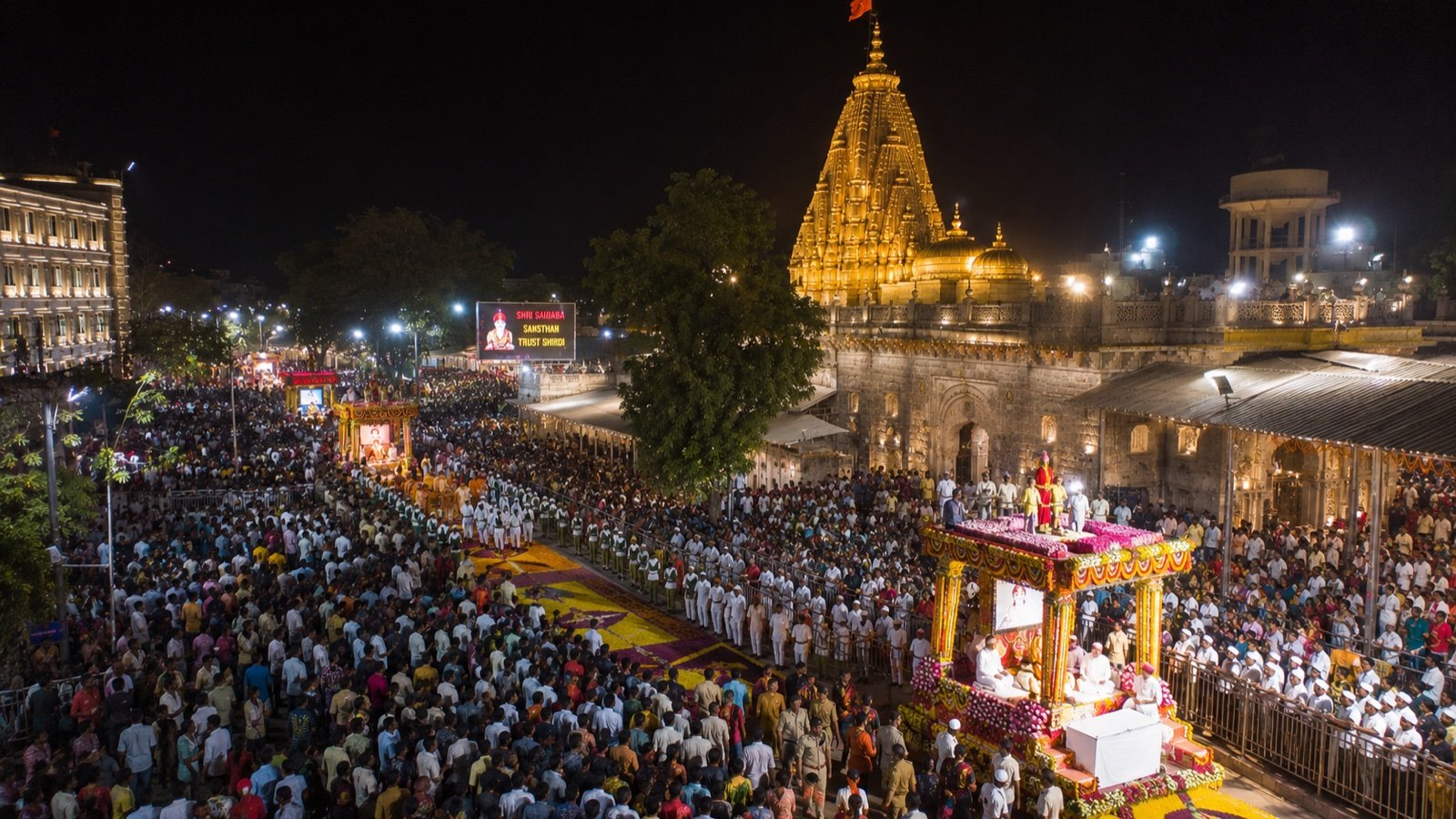
The rhythm of every day in Shirdi
Kakad before sunrise, Madhyan at noon, Dhoop at sunset, Shej at night — the schedule and meaning of the four aartis.
Every day at the Samadhi Mandir in Shirdi is shaped by four aartis. Each is a complete devotional service of roughly thirty minutes — songs, abhishek, naivedya offering, mantra recitation and the closing chant of “Sri Sachidananda Sadguru Sainath Maharaj Ki Jai”. This page is a practical reference to Shirdi aarti timings, the meaning of each aarti, how to attend, and how to obtain a pass. For the very latest schedule changes — especially on festival days — always confirm with the official Shri Sai Baba Sansthan Trust.
Darshan timings: the Samadhi Mandir opens at 4:45 AM and darshan begins at 6:25 AM, once Kakad Aarti and the Mangal Snaan are done. Darshan then runs through the day, pausing briefly for each aarti, until the temple closes shortly after Shej Aarti at 10:00 PM. That programme is the same every day of the week — only festival days and the Thursday palki change it.
The four aartis at a glance
Sai Baba himself never sat for a formal aarti during his lifetime — he objected to the idea of being worshipped as a deity. The four aarti tradition began only in 1909, when devotees finally persuaded him to allow a Madhyan Aarti. Over the following decade the cycle expanded to four times a day, and the songs sung were composed by Krishnaji Keshav Jogalekar, Mahalsapati and other early disciples. After Baba’s mahasamadhi in 1918 the aartis were continued at the Samadhi as a daily worship cycle, and they have run unbroken since.
Kakad Aarti
The morning wake-up aarti. Soft, almost lullaby-like, sung as Baba is “awoken”. Quietest in mood; often the most spiritually intimate.
Read GuideMadhyan Aarti
The noon aarti. The loudest and most attended, includes the naivedya offering of cooked food to Baba. Crowds peak here on Thursdays.
Read GuideDhoop Aarti
The evening aarti, timed with sunset (so shifts through the year — 6:00 PM in winter, 7:00 PM in summer). Frankincense and oil lamps; the most atmospheric.
Read GuideShej Aarti
The night aarti. Baba is “put to sleep” — a folded shawl is placed beside the murti and a sandalwood mark applied. Lights dim afterwards.
Read GuideKakad Aarti — waking the Sadguru
Kakad Aarti begins at approximately 5:15 AM, the hour when the village is still dark and only the temple lights glow against the night sky. The word kakad means “wick” — the priests light wicks dipped in ghee to gently rouse Baba from sleep. The accompanying songs are slow, lyrical, written in Marathi and Hindi, and many devotees consider this the most intimate of the four aartis.
To attend Kakad in the queue hall, reach the temple complex by 4:30 AM. To sit inside the sanctum near the murti you require a Kakad Aarti pass, released by the Trust’s online booking system in limited numbers. The morning is cold for most of the year — wear a shawl or sweater between November and February.
Madhyan Aarti — the noon offering
Madhyan Aarti begins at 12:00 PM sharp and is the busiest of the four. The aarti includes the naivedya ceremony — a tray of cooked rice, dal, sweets and curd is offered to the murti and later distributed as prasad. The songs sung are the well-known Aarti Sai Baba attributed to Madhav Adkar, followed by Shirdi Majhe Pandharpur and the closing mantra-pushpanjali.
On Thursdays — Baba’s day — the Madhyan Aarti hall fills two hours in advance. If you intend to sit inside, arrive with your pass by 10 AM. For ordinary queue darshan during Madhyan Aarti, the queue is paused while the aarti is in progress and resumes immediately after. Plan accordingly so you are not stuck in the middle of a 30-minute pause if you have a train to catch.
Dhoop Aarti — the sunset aarti
Dhoop Aarti is the only one of the four with a sliding time. It is performed at sunset, which means roughly 6:00 PM in December and as late as 7:15 PM in June. The Trust publishes the exact daily Dhoop time on its main notice board and on sai.org.in. The aarti is named after the dhoop — frankincense and sambrani smoke — that the priests wave in front of the murti.
For many seasoned devotees, Dhoop is the most beautiful aarti to attend. The hall lights are dimmed, oil lamps line the silver railing, the smoke catches the last orange light from the western doors, and the songs (including Aarti Uddhava Shantida) are sung at a more measured pace than at Madhyan. If you can only attend one aarti in your yatra, attempt Dhoop.
Dhoop Aarti time by month — approximate sunset at Shirdi
Because Dhoop Aarti follows sunset, its start time moves by about eighty-five minutes across the year. The table below gives the sunset window for Shirdi (19.77° N, 74.48° E) in each month, rounded to the nearest five minutes. Use it to plan which evening to keep free — the Sansthan fixes the exact time each day and posts it on the queue complex notice board, so treat these as a planning guide rather than a booking time.
| Month | Dhoop Aarti begins (approx.) |
|---|---|
| January | 6:05 – 6:25 PM |
| February | 6:25 – 6:35 PM |
| March | 6:35 – 6:45 PM |
| April | 6:45 – 6:55 PM |
| May | 6:55 – 7:05 PM |
| June | 7:05 – 7:15 PM |
| July | 7:10 – 7:15 PM |
| August | 6:50 – 7:10 PM |
| September | 6:20 – 6:50 PM |
| October | 6:00 – 6:20 PM |
| November | 5:50 – 6:00 PM |
| December | 5:50 – 6:05 PM |
The earliest Dhoop Aarti of the year falls in the second half of November, at roughly 5:50 PM. The latest is in late June and early July, at roughly 7:15 PM. If you are planning a single evening in Shirdi, aim to be through security and inside the Samadhi Mandir queue well before the time shown for your month — the hall fills long before the aarti starts.
Shej Aarti — putting Baba to rest
Shej Aarti begins at 10:00 PM and is the closing service of the day. The word shej means “bed”, and the aarti symbolically puts Baba to rest. After the songs, a folded white shawl is placed beside the murti, a sandalwood paste mark is applied to the forehead, and the silver doors of the sanctum are closed for the night at approximately 11:30 PM. The whole temple compound empties out by midnight.
Shej Aarti is the quietest of the four because most day-pilgrims have already left Shirdi by evening. Devotees who stay overnight at the Bhakta Niwas often attend Shej as their final act of the day before returning to their rooms.
The full daily programme at the Samadhi Mandir
The four aartis are the anchors of the day, but the Sansthan runs a longer published programme around them. This is the sequence as listed by the Shri Saibaba Sansthan Trust — useful if you want to catch the quieter rituals that most day-trippers miss.
| Time | What happens |
|---|---|
| 4:45 AM | Temple opens |
| 5:00 AM | Bhupali — the waking hymn |
| 5:15 AM | Kakad Aarti (morning) |
| 5:50 AM | Mangal Snaan in the Samadhi Mandir — the ceremonial bath |
| 6:20 AM | Aarti “Shirdi Majhe Pandharpur” |
| 6:25 AM | Darshan begins in the Samadhi Mandir |
| 11:30 AM | Dhuni Pooja with rice and ghee in Dwarkamai |
| 12:00 PM | Madhyan Aarti (mid-day) |
| 4:00 PM | Pothi — devotional reading in the Samadhi Mandir |
| At sunset | Dhoop Aarti |
| 8:30 – 10:00 PM | Devotional songs and cultural programmes in the Samadhi Mandir |
| 10:00 PM | Shej Aarti |
Two of these are worth planning around. Mangal Snaan at 5:50 AM is the ceremonial bathing of the murti and is far less crowded than Kakad Aarti forty minutes earlier. Dhuni Pooja at 11:30 AM in Dwarkamai happens at the sacred fire Baba himself kept burning, and most pilgrims walk past it on their way to the noon aarti without realising it is under way. Source: the Trust’s published daily programme at sai.org.in.
Special Thursday — the palki to Chavadi
Thursdays at Shirdi end with one of the most beloved traditions in Indian temple life — the Chavadi procession. After Shej Aarti, a palanquin carrying Baba’s photograph and silver paduka is taken in torchlight procession from the Samadhi Mandir to the Chavadi, the rest-house where Baba slept on alternate nights during his lifetime. The procession is accompanied by chanting, bhajans, drums and the sound of bells. Devotees line both sides of the lane. The palki is housed at Chavadi for the night and returned the next morning. This tradition has run unbroken since Baba’s own lifetime.
Festival days — extended aarti schedules
On the four principal festivals of Ram Navami, Guru Purnima, Sai Punyatithi and Datta Jayanti, the regular aarti schedule is supplemented with extra ceremonies — abhishek puja, mahapuja, palki processions and akhand parayan of the Sai Satcharitra through the night. Sai Punyatithi on Vijaya Dashami (20 October 2026) is the most elaborate, with three days of continuous worship, special bhajan sandhya and a full-village palki procession. Pilgrims attending these festivals should expect aartis to run slightly delayed and queues to be paused longer. Always check sai.org.in for the festival-day schedule a week in advance.
How to attend an aarti from inside the sanctum
There are three categories of aarti attendance:
Queue-hall attendance
Free. Join the regular queue at the relevant time. You will be inside the temple hall during the aarti and can hear and see the proceedings on the live feed. No booking required.
Aarti pass (sanctum seating)
Paid. Limited number of passes per aarti per day, released online through the Trust’s portal weeks in advance. Lets you sit on the carpeted area inside the sanctum, within a few feet of the murti. See our aarti booking page for details.
VIP pass
Premium. Offered for select aartis with closer access. Subject to availability and Trust discretion. See our VIP darshan pass guide.
Aarti pass prices and where to book
The aarti pass is priced per person: ₹600 for Kakad Aarti and ₹400 each for Madhyan, Dhoop and Shej. Every adult on a booking pays the full rate, and the portal adds a small online reservation charge at checkout, so your total runs slightly higher. Rates can change by Trust resolution, so confirm the live amount on the official portal before you pay. Note that the aarti pass is a separate ticket from the ₹200 paid darshan pass — one does not include the other.
Passes are sold through exactly three channels: the Trust’s portal at online.sai.org.in, the official Sansthan mobile app, and in person at the PRO office in Shirdi. No travel agent, hotel desk or third-party website has any authority to sell them. You will need one government photo ID per adult, and the named devotee must attend with that same original ID — a mismatch at the gate ends the trip at the barrier. Refunds and rescheduling are not part of the normal process once a pass is issued, so fix your travel first and buy the pass second.
If your chosen aarti is sold out
Kakad and Shej passes for Thursdays and festival days often clear a day or more in advance. When a slot shows unavailable, switch the aarti rather than the day — Madhyan and Dhoop passes usually last longer. Recheck the portal late at night, since cancelled bookings sometimes return to the pool, or try the PRO office counter in person. Failing that, screens in the Sabha Mandap and the courtyard relay every aarti live at no cost.
What to expect once you are inside
If you have an aarti pass, you will be directed to a separate entrance about 45 minutes before the aarti begins. Phones, cameras and shoes are deposited. You walk barefoot through a side corridor into the inner Sabha Mandap and are seated cross-legged on the carpet in rows. Priests in traditional attire arrive about ten minutes before the aarti and begin the ritual preparations. The singing starts on cue, the conch is blown, the priest performs the wave of light and incense before the murti, and devotees sing along — the lyrics are printed on a sheet handed out at entry or known by heart.
The aarti lasts about thirty to forty minutes. At the end, devotees rise, fold their hands toward the murti, receive a sprinkle of teertha water and a small portion of prasad, and exit through the side door. You are not permitted to linger in the sanctum after the aarti — the next batch of darshan pilgrims must move through.
Aarti at home — parayan tradition
For devotees who cannot reach Shirdi, the four aartis are performed at home through the recitation of the printed Sai Aarti book (available at every Sansthan counter and in PDF on sai.org.in). Most households maintain a weekly Thursday cycle — one aarti in the morning and one in the evening — and an annual Sai Satcharitra parayan across seven days. The discipline is simple, beautiful, and entirely the devotee’s own.
Approximate yearly schedule note
All timings published here are derived from long-standing tradition and from announcements on sai.org.in. For pilgrims arriving for a specific aarti, always confirm the day’s exact time at the queue complex notice board upon arrival. The Trust occasionally adjusts schedules during festivals, eclipses or VIP visits.
Where to go next
Now that you understand the four aartis, the natural next steps are: read our Shirdi darshan guide for queue logistics, plan your aarti pass booking if you want sanctum seating, study our VIP darshan pass page for premium options, or read the life of Sai Baba to understand the meaning behind the songs. For travel and stay, see how to reach Shirdi and Bhakta Niwas accommodation.
Frequently Asked Questions
What are the Shirdi aarti timings?
The four daily aartis at Shirdi are Kakad Aarti at approximately 5:15 AM, Madhyan Aarti at 12:00 PM, Dhoop Aarti at sunset (variable through the year), and Shej Aarti at approximately 10:00 PM. The temple closes shortly after Shej Aarti at around 11:30 PM.
What are the Shirdi darshan timings?
The Samadhi Mandir opens at 4:45 AM and darshan begins at 6:25 AM, after Kakad Aarti and the Mangal Snaan. Darshan continues through the day, pausing briefly for each aarti, until the temple closes shortly after Shej Aarti at 10:00 PM. This is the standing daily programme published by the Shri Saibaba Sansthan Trust and it is the same every day of the week; only festival days and the Thursday palki procession change it.
Is Dhoop Aarti at a fixed time?
No, Dhoop Aarti is the only aarti with a sliding time. It is performed at sunset, which varies from approximately 6:00 PM in December to 7:15 PM in June. The Sansthan posts the exact daily Dhoop Aarti time on the queue complex notice board and on its website.
Can I attend Shirdi aarti without a pass?
Yes. Any pilgrim in the regular free queue at the time of an aarti will be inside the queue hall and can witness the aarti through the live feed and from the back of the Sabha Mandap. A pass is required only to sit inside the inner sanctum during the aarti.
How do I book a Shirdi aarti pass?
Aarti passes are issued by the Shri Sai Baba Sansthan Trust through its official online booking portal at sai.org.in. Passes are released several weeks ahead of the date, in limited numbers, and are bookable on a first-come basis. Our aarti booking online page explains the process in detail.
What is the most attended aarti at Shirdi?
Madhyan Aarti at 12:00 PM is the most attended of the four daily aartis. It includes the naivedya cooked-food offering and draws the largest crowds, particularly on Thursdays and festival days. Dhoop Aarti at sunset is considered the most atmospheric for first-time pilgrims.
What happens during the Thursday palki at Shirdi?
Every Thursday night, after Shej Aarti, a palanquin carrying Sai Baba’s photograph and silver paduka is taken in torchlight procession from the Samadhi Mandir to Chavadi, where Baba slept on alternate nights during his lifetime. The palki is accompanied by drums, bhajans and chanting and is one of Shirdi’s most beloved traditions.
Are there changes to aarti timings on festival days?
Yes. On Ram Navami, Guru Purnima, Sai Punyatithi and Datta Jayanti, the regular aarti schedule is supplemented with extra ceremonies including abhishek, mahapuja, palki processions and overnight Sai Satcharitra parayan. Aartis may run slightly delayed. Check sai.org.in a week in advance.
Can I sing along during the aarti?
Yes, devotees are warmly encouraged to sing along. The aarti lyrics in Marathi and Hindi are printed on small booklets available at every Sansthan counter. Many regular devotees know the four aartis by heart. Maintain respectful volume — the priest’s chant remains the lead.
