Shirdi pooja booking covers three paid rituals of the Shree Saibaba Sansthan Trust, which runs the Samadhi Mandir in Shirdi. They are the Shree Sai Satyavrata Pooja, the Abhishek Pooja and a pooja for a new vehicle. A Satyavrata or Abhishek ticket costs ₹100, while a vehicle pooja costs ₹51 or ₹151.
Each pooja has a place of its own — two halls, and the spot outside Gate No. 4 for a new vehicle. Because the vehicle pooja registers at the donation office, it is the one you cannot book online.
We write as an independent editorial team, and this site is not affiliated with the Shree Saibaba Sansthan Trust. Please register on the Sansthan portal at online.sai.org.in, because we never take a booking or a payment.
On This Page
Shirdi pooja booking at a glance
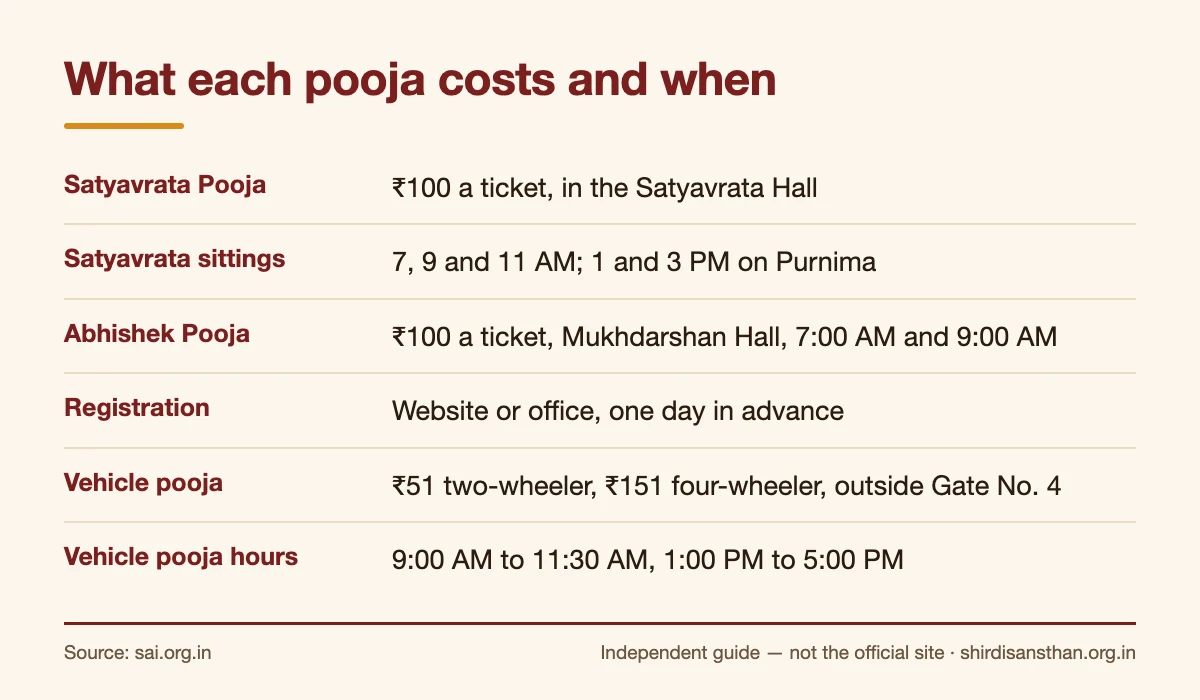
The Sansthan fixes a place, an hour and a ticket price for each of its three daily rituals. The two hall poojas also hand the devotee a prasad to carry home.
Shree Sai Satyavrata Pooja: ₹100, in a hall behind the Shani Temple
Chapter 13 of the Shree Sai Satcharita holds the story behind this pooja. Bhimaji Patil of Narayangaon lived with a long illness, and no treatment helped him. Then, on Nanasaheb Chandorkar’s advice, he took refuge in Sai Baba, whose blessings ended the illness. Since he saw Baba as an incarnation of Shree Narayana, the Satyavrata tradition grew from that.
The sitting happens in the Shree Sai Satyavrata Hall, behind the Shani Temple. Three sittings run through the morning, at 7:00 AM, 9:00 AM and 11:00 AM. When a full moon falls, the Sansthan opens two more, at 1:00 PM and 3:00 PM. A ticket costs ₹100.
One ticket seats one person, although a husband and wife take a sitting together. The Sansthan supplies every pooja material, so you reach the hall empty-handed. Each devotee then carries home a coconut with shiraprasad, the sweet offering.
Registering for a Satyavrata sitting
Registration runs through the Sansthan website, or over the counter at its office, one day before the pooja. A ticket in hand before the pooja starts is compulsory. For the portal screens, read our walkthrough of the Shirdi booking portal.
Abhishek Pooja in the Mukhdarshan Hall
This pooja honours the Panchadhatu idol of Shree Sai, cast in five metals, and it carries the wishes of the devotees who sit for it. The Mukhdarshan Hall holds it. Our darshan queue guide explains where the mukh darshan line runs.
A ticket costs ₹100 here too. Two sittings run each morning, from 7:00 AM to 8:00 AM and from 9:00 AM to 10:00 AM. One ticket again seats one person, and the Sansthan provides the materials. When the sitting ends, the prasad is a ladoo packet with a coconut.
Shirdi pooja booking for a new vehicle
Devotees who buy a new vehicle bring it to the spot outside Gate No. 4 of the temple premises. A two-wheeler pooja costs ₹51, while a four-wheeler pooja costs ₹151. Registration happens in person, at the donation office of the Sansthan.
The vehicle pooja runs from 9:00 AM to 11:30 AM, then again from 1:00 PM to 5:00 PM. It pauses for aarti, so check the Shirdi aarti timings before you drive in. Pack three things before you set out: a pedha or other prasad to offer, one fruit, and garlands for the idol.
Planning the day around your sitting
The 7:00 AM slot leaves the rest of the morning free for darshan, and our darshan guide explains those queues. An 11:00 AM sitting, on the other hand, gives room for a late arrival in Shirdi. A full moon day opens the 1:00 PM and 3:00 PM sittings as well.
Shirdi pooja booking questions devotees ask
Can I register on the day of the pooja?
The Sansthan takes registration one day in advance, online or at its office. So fix the sitting before you travel to Shirdi.
What does the ₹100 ticket cover?
One person sits per ticket, and the Sansthan hands over every pooja material. Afterwards a Satyavrata sitting gives a coconut with shiraprasad, while an Abhishek sitting gives a ladoo packet with a coconut.
Where do I pay for a vehicle pooja?
At the donation office of the Sansthan, in person. The pooja itself happens outside Gate No. 4, between 9:00 AM and 11:30 AM and again between 1:00 PM and 5:00 PM.
Featured photo: Photographer in Shirdi, India via Wikimedia Commons, Public domain, adapted (cropped, shaded and titled).