Samadhi Mandir Shirdi — Inside the Holy Shrine
The full story of Sai Baba's samadhi shrine — Bapusaheb Buty's 1922 wada turned temple, the marble murti, the silver Singhasan and what devotees experience inside.
The samadhi mandir shirdi is the heart of every devotee’s journey to Sai Baba — the white-marble shrine that holds his earthly samadhi (tomb), crowned by a luminous life-size statue and the silver Singhasan that has become the most photographed image of any Indian guru. Built in 1922 over what was originally Shri Bapusaheb Buty’s private residence, the mandir is today managed by the Shri Sai Baba Sansthan Trust and draws over 25,000 devotees on a quiet day, rising to a lakh and more during festivals. This is an independent devotee guide to its history, architecture, aarti routine and the experience of standing before Baba — we are not affiliated with the official Trust at sai.org.in.
The Story Behind the Shrine
To understand the Samadhi Mandir you have to go back to a single dream. In the early 1900s, a wealthy Nagpur devotee named Shri Bapusaheb Buty was in Shirdi when he had a vision in which Sai Baba seemed to tell him to build a temple of Krishna. With Baba’s blessings, Buty bought a plot near the Dwarkamai and started construction of a stone wada (mansion) with a sanctum intended for the Krishna idol.
In October 1918, before the idol could be installed, Sai Baba’s health declined. On 15 October 1918 (Vijayadashami), Baba left his body. According to multiple accounts in the Sai Satcharitra, Baba had earlier remarked that he would be brought to Buty’s wada after his samadhi. His mortal remains were laid to rest in the very sanctum that had been prepared for Krishna — and the wada became the Samadhi Mandir we know today.
I shall be active and vigorous even from the tomb.
For more than three decades, the shrine consisted of the samadhi itself and a portrait of Baba. The famous white-marble murti we see today was added much later, in 1954.
The Marble Murti and Its Sculptor
A statue carved from a single block
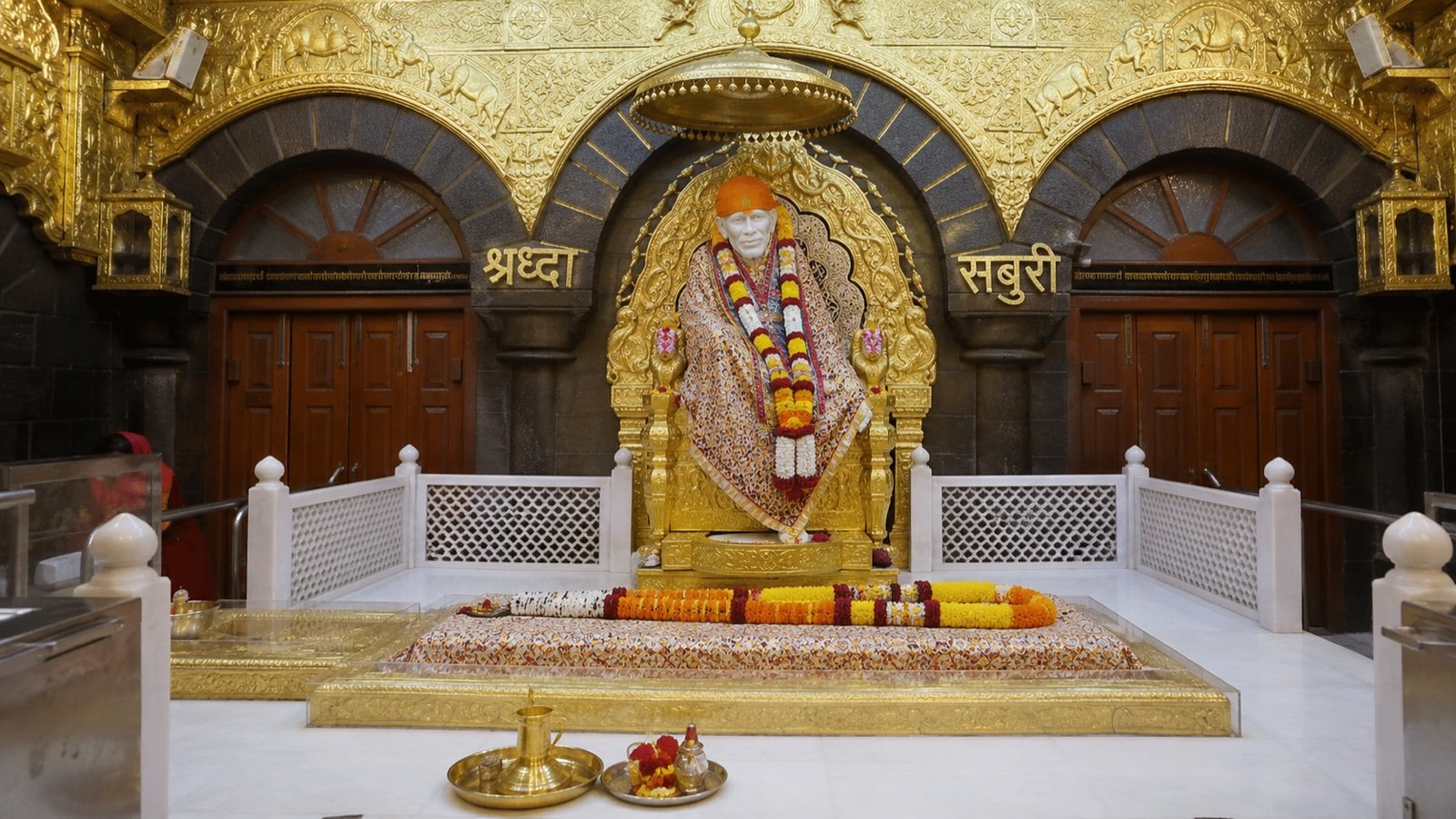
The life-size statue of Sai Baba seated on the silver Singhasan was sculpted by Shri Balaji Vasant Talim, a master sculptor from Mumbai. Talim carved the murti from a single block of pure Italian white marble, depicting Baba in his iconic seated posture — right leg crossed over the left, one hand resting on the knee, the other in a gentle blessing gesture, eyes calm and direct.
The murti was installed in the Samadhi Mandir on 7 October 1954. Devotees who first saw it described an uncanny resemblance to photographs of Baba taken in his lifetime. Over the decades, the murti has been adorned with elaborate vastra (robes) that change with the day and the season — saffron on most days, royal silks during festivals, simple white during certain quiet observances.
Behind the murti rises the famous silver throne, the Singhasan, and around it the marble pedestal that covers the actual samadhi (tomb) of Sai Baba. The combination of marble murti above and unseen samadhi below is what makes this shrine so unique among Indian temples.
Architecture and Layout
The Samadhi Mandir as it stands today is a much-expanded structure that has grown around the original Buty wada. The Shri Sai Baba Sansthan Trust has added queue corridors, darshan halls, prasad counters and security infrastructure to handle the millions of pilgrims who visit each year — while preserving the original sanctum and its sacred geometry.
The Sanctum
Houses the marble murti, silver Singhasan and the samadhi itself. Closed to general public for direct access; viewed through the darshan hall.
Read GuideDarshan Hall
The large pillared hall in front of the sanctum from which devotees offer prayers. Aartis take place here. Capacity around 600-700 seated.
Read GuideQueue Corridors
Separate corridors for free queue, VIP queue, aarti pass holders and senior citizens / divyang queue. All converge in the darshan hall.
Read GuidePrasadalaya
Trust-run community kitchen serving simple sattvic meals to thousands of devotees daily at subsidised cost.
Read GuidePrasad Counters
Free Udi (sacred ash) and a small sweet handed out at the exit. Laddoo prasad packets sold at separate counter.
Read GuideTrust Office
Booking counters, donation receipts, IDs verification, helpline desk — all within the same complex.
Read Guide
Timings — When the Mandir Is Open
The Four Daily Aartis
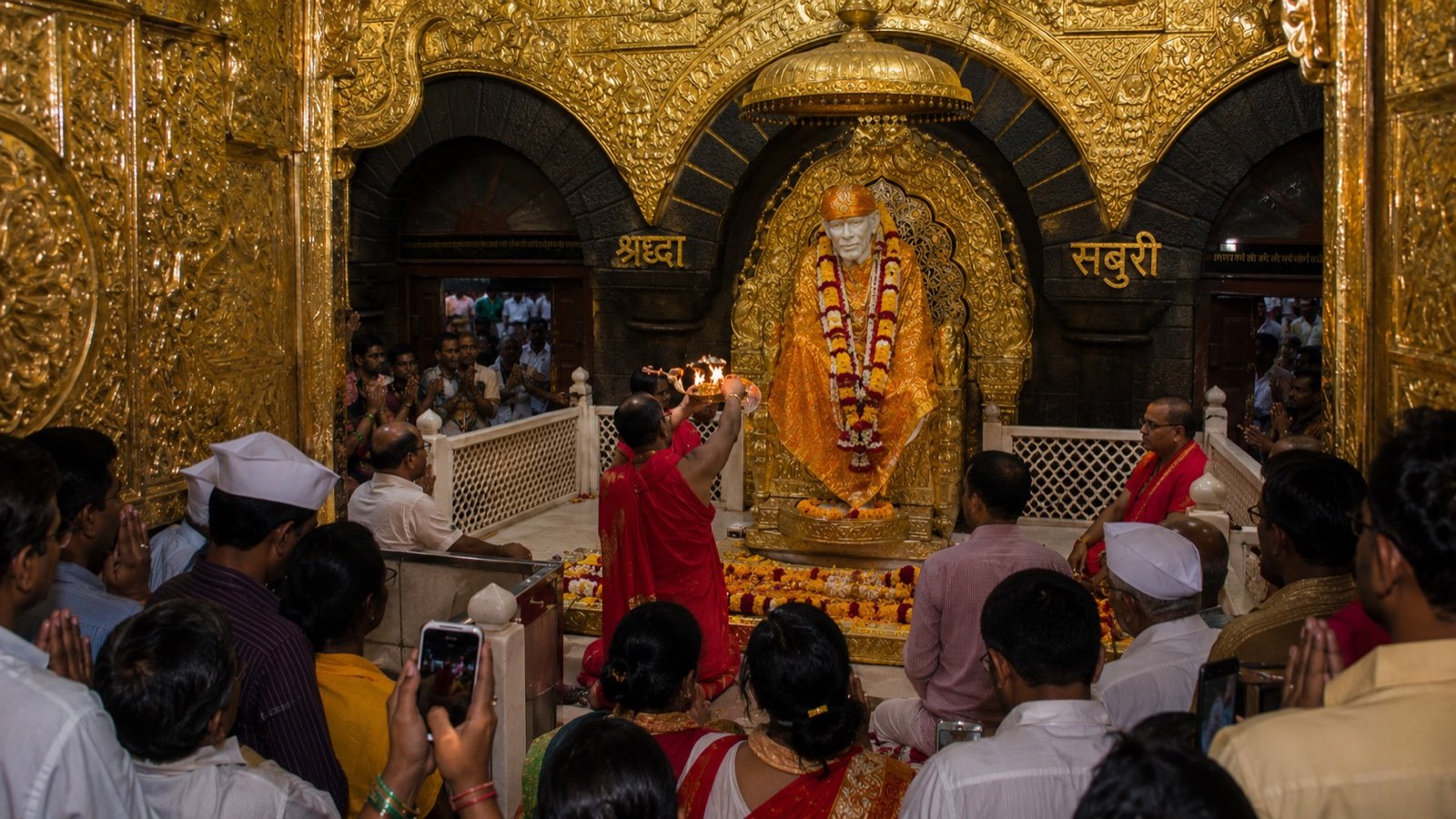
Four aartis are performed inside the Samadhi Mandir every day in front of Baba’s murti. They follow the daily routine that Sai Baba himself observed in the Dwarkamai during his lifetime, adapted into a formal ritual by his close devotees after his samadhi.
Kakad Aarti — ~5:15 AM
The waking aarti. Devotees offer flowers and chant verses to wake Baba. The murti is bathed and dressed in fresh vastra. Cold, quiet morning — magical to attend.
Madhyan Aarti — ~12:00 PM
The noon aarti, performed before bhog (offering of food) is presented to Baba. This is the most attended aarti, with the largest crowd in the hall.
Dhoop Aarti — ~sunset
Sunset aarti, performed as dusk falls. Lamps are lit, dhoop (incense) is offered, and the hall fills with the smell of camphor and frankincense.
Shej Aarti — ~10:00 PM
The night aarti — Baba is symbolically put to rest. A pillow and shawl are placed on the sanctum. The mandir closes for the night soon after.
If you want to attend any of these from a reserved seat rather than the standing crowd, book an aarti pass online — see our complete aarti booking guide.
What Happens Inside the Darshan Hall
The darshan flow inside the Samadhi Mandir is one of the most carefully managed pilgrim crowd-control systems in India. Whether you enter through the free queue, the VIP darshan pass queue, or the senior citizens queue, all corridors converge into the same darshan hall about 20 metres before the sanctum.
You walk forward with the queue. The hall is large, beautifully lit, with high ceilings and pillars. As you approach the sanctum, you see the marble murti of Sai Baba seated on the silver Singhasan, surrounded by vastra, garlands and fresh flowers offered by previous devotees. The samadhi itself is below the murti, covered by the marble pedestal — devotees believe Baba’s energy still emanates from there.
You fold your hands, look at Baba, perhaps whisper a prayer or a wish. The line keeps moving — staff will gently guide you so others get their darshan too. The whole encounter, in the queue line itself, takes about 20 to 40 seconds. What it leaves with you is something most devotees describe as inexpressible.
Dress Code and Etiquette
The Shri Sai Baba Sansthan Trust does not enforce a strict temple-style dress code — devotees from many traditions and faiths visit, and the temple is open to everyone — but a few simple guidelines help maintain the devotional atmosphere.
Modest clothing
Cotton kurta-pyjama, salwar kameez, saree, churidar, or simple shirt-trouser. Avoid sleeveless tops, very short skirts or beach wear.
Read GuideNo shoes inside
Shoes are removed at designated stands. Bring a small cloth bag if you want to carry your footwear with you, otherwise use the free stand.
Read GuideNo phones
Phones, cameras and video recorders are not permitted inside the sanctum or aarti hall. Use the free cloakroom on Pimpalwadi Road.
Read GuideSilent or low voice
Speak in whispers inside the hall. No flash photography in queue corridors. Keep children close so they don’t run.
Read GuideNo prasad inside
Food brought from outside is not allowed inside the sanctum hall. Eat at the Trust prasadalaya or outside before entering.
Read GuideWheelchair access
The Trust provides wheelchair assistance through the senior citizens / divyang queue. Ramps are present at all entry corridors.
Read GuideRead the full Shirdi yatra rules and dress code page for a more detailed orientation before your trip.
Festivals and Special Days
Three festivals reshape the Samadhi Mandir every year. On Ramnavami (March-April), the temple celebrates Sai Baba’s spiritual birth with massive processions, urs ceremonies and continuous bhajans. On Guru Purnima (July), devotees from every state arrive to honour Baba as their guru, and the mandir runs aartis through the night. On Vijayadashami / Punyatithi (October), the anniversary of Sai Baba’s samadhi, the temple holds special prayers, a grand abhishek and three days of continuous bhakti programmes. Find the 2026 dates in our festival calendar.
The Mandir Complex Beyond the Sanctum
The Samadhi Mandir does not stand alone. Within a five-minute walk you can visit several other sites deeply associated with Sai Baba’s life — places he sat, slept, ate, taught and walked. Most devotees combine all of these into a single afternoon of quiet darshan.
Dwarkamai
The old mosque where Sai Baba lived for nearly 60 years. The sacred dhuni still burns. A 2-minute walk from the Samadhi.
Read GuideChavadi
The small wooden structure where Sai Baba slept on alternate nights. Now houses Baba’s bed. Thursday night procession is famous.
Read GuideGurusthan
The neem tree under which Sai Baba was first seen as a young boy. Said to be the seat of his own guru. Sacred meditation spot.
Read GuideKhandoba Mandir
The temple at the village outskirts where Sai Baba was first welcomed with the words “Aao Sai” — giving him his name.
Read Guide
Inside the Sanctum — Details Most Devotees Miss
The oldest part of the shrine ends at a row of stone arches — the reason locals called Buty’s original building the dagadi wada, or stone mansion. The Trust later extended the mandir backwards, adding a further hall in 1998 as crowds grew.
At the sanctum, the samadhi is ringed by an ornamental railing. Devotees bow there; attendants receive every offering — your garland, shawl or sweet is offered on your behalf. Cloth donated for the statue later reaches the Sansthan shop, and many devotees buy it back for their home altars. Decide your sequence before the railing: the tomb first, then the statue’s face, then bow.
The display recess of Baba’s belongings
Exit past the display recess holding objects Baba used in his lifetime — three pairs of sandals, his folded clothes in a glass-fronted cupboard, chillims, a grinding stone, a silver palanquin, ornaments of his horse Shyam Sunder, and the photograph that stood on the tomb throne until 1954. Baba himself cooked in the large copper pots kept here, feeding fifty to two hundred villagers and stirring the food with his bare hand, according to the Sai Satcharitra. It is the one corner of the shrine where nobody hurries you.
On Thursday evenings, Baba’s satka and padukas are placed before the tomb from around 7:30 PM until the procession carries them to the Chavadi — the only window when those objects come within reach at the samadhi.
The Other Sacred Sites Around the Samadhi Mandir
Three more sites — two inside the temple complex and one at the old village edge — complete the sacred circle of Sai Baba’s Shirdi. Each is free to visit, and each carries a chapter of his story that the main shrine alone cannot tell.
Gurusthan — the neem tree where Shirdi first saw Sai Baba
Gurusthan is a small raised platform around an ancient neem tree inside the Samadhi Mandir complex, barely fifty metres from the main shrine exit. According to the Sai Satcharitra, this is the ground where the villagers of Shirdi first saw Sai Baba around 1854 — a young fakir of about sixteen, meditating beneath the tree. When devotees later asked who his guru was, Baba pointed to this spot and said, “This is my Guru’s place.” The platform holds a pair of silver padukas marking where Baba sat, a garlanded portrait, a Shiva lingam and Nandi, an oil lamp kept lit at all hours, and brass bells. The leaves of this particular neem are famously said to taste sweet, not bitter — the Satcharitra records that Baba himself drew attention to this as a sign of the spot’s sanctity.
The Gurusthan pooja is free — no ticket, no booking, no fee to any website. Light a single agarbatti at the stand, walk clockwise around the platform three times, bow at the padukas, and take one offered neem leaf from the basket as prasad (do not pluck from the tree). Thursdays and Fridays draw the largest crowds; the shrine keeps the same hours as the main temple, and a calm darshan takes ten to fifteen minutes. On Mondays a small Shiva-lingam abhishek is held for a nominal fee at the Sansthan counter; the platform itself is barefoot only.
Khandoba Mandir — where Sai Baba got his name
The Khandoba Mandir stands at the old village entrance, about 700 metres — a ten-minute walk — from the Samadhi Mandir. Around 1858 a wedding party from Dhupkheda halted here, and the priest Mhalsapati, seeing a young unnamed fakir with the procession, greeted him with the words “Ya Sai” — welcome, holy one. That greeting gave Sai Baba the name by which the world worships him, and Mhalsapati went on to become Baba’s closest companion. Khandoba is a folk warrior-form of Lord Shiva worshipped across Maharashtra; inside the small stone sanctum his lingam sits wrapped in turmeric bhandara, and a stone slab marks the spot where Mhalsapati stood when he first saw the young fakir.
This is an independent village temple maintained by local priests, not by the Sansthan. It is generally open from sunrise to around 9 PM, with no queue and no entry ticket; photography is allowed in the outer courtyard but not inside the sanctum, and modest dress applies as at any Shiva shrine. It is rarely crowded — many seasoned devotees begin their yatra here, where the story of the name “Sai” began, before continuing to Gurusthan, Dwarkamai and the main darshan.
Lendi Baug and the Nanda Deep — Baba’s garden and eternal lamp
Lendi Baug, roughly five minutes on foot from the Samadhi Mandir past Dwarkamai, holds the Nanda Deep (also called Akhanda Deep) — a perpetually burning oil lamp that Sai Baba lit with his own hands and told his attendant Abdul Baba to keep fed. The Sansthan maintains the flame today inside a marble lamp house, and it has never been ritually extinguished. The lamp stands between a neem and a bodhi tree that Baba planted side by side — bodhi is the tree commonly called peepal; guides that say banyan are repeating a copied error. The garden also holds a small Datta Mandir, the well Baba dug with devotees, the samadhi of Shyam Sunder — Baba’s horse — and devotee samadhis at the entrance, including Abdul Baba’s.
Entry is free and there is no queue. Worship here is simple: a slow clockwise pradakshina around the lamp and trees, folded hands, and quiet sitting. No bookable Nanda Deep pooja exists — the Trust’s only bookable poojas are the Satyavrata, Abhishek and Vehicle poojas, none of them held at Lendi Baug, so treat any website selling a “Nanda Deep seva” as unauthorised. You cannot pour oil into the lamp yourself; offerings of oil or ghee go through the official donation counters inside the complex. Allow 20 to 40 minutes — the garden is quietest during the aarti hours, when the crowd moves to the mandir.
Frequently Asked Questions
When was the Samadhi Mandir in Shirdi built?
The shrine was originally built in 1922 as the wada of Shri Bapusaheb Buty, a Nagpur devotee. After Sai Baba left his body on Vijayadashami 1918, his samadhi was placed in the sanctum prepared for a Krishna idol, and the wada became the Samadhi Mandir.
Who sculpted the marble statue of Sai Baba?
The life-size marble murti was sculpted by Shri Balaji Vasant Talim, a master sculptor from Mumbai. It was carved from a single block of pure Italian white marble and installed in the Samadhi Mandir on 7 October 1954.
What are the Samadhi Mandir timings?
The Samadhi Mandir opens at 4:45 AM with preparations for Kakad Aarti and closes around 11:30 PM after Shej Aarti. The four daily aartis are at approximately 5:15 AM, 12:00 PM, sunset and 10:00 PM, with slight seasonal variation.
Is the samadhi of Sai Baba actually below the marble statue?
Yes, the actual samadhi (tomb) where Sai Baba’s mortal remains are interred lies directly below the marble murti and silver Singhasan in the sanctum. The marble pedestal you see covers the samadhi itself, which is why this shrine is so deeply revered.
Can I take photos inside the Samadhi Mandir?
No, phones, cameras and video recorders are not permitted inside the sanctum or aarti hall. Photography is allowed in the outer complex courtyard. Deposit your camera and phone at the free Trust cloakroom on Pimpalwadi Road before entering.
Is the Samadhi Mandir open to people of all faiths?
Yes, the mandir welcomes devotees from every faith, caste, nationality and background. Sai Baba’s own teaching — Sabka Malik Ek (one God is the master of all) — runs through the Trust’s open-door policy. There is no entry fee for the free darshan queue.
How long does it take to get darshan inside the Samadhi Mandir?
On a quiet weekday morning the free queue takes 30 to 60 minutes; on Thursdays and festival days it can stretch to three or four hours. A Rs 200 VIP darshan pass cuts the wait to roughly 30 to 90 minutes in most conditions.
What aartis are performed at the Samadhi Mandir?
Four aartis are performed daily inside the Samadhi Mandir — Kakad Aarti at ~5:15 AM, Madhyan Aarti at ~12:00 PM, Dhoop Aarti at sunset, and Shej Aarti at ~10:00 PM. All four take place in the main darshan hall in front of the marble murti.
